
Wide-Plank Engineered Oak
Wide-plank oak floors — up to 300mm, hand-finished.
European white oak in 140mm, 180mm, 220mm, 260mm and 300mm widths — single planks reading the full span of a kitchen-diner or atrium, engineered-built for stability over screed and underfloor heating, random lengths up to 2.5m+ for the country-house look, hand-finished on site in natural, smoked, fumed, limewashed or character-grade brushed-and-oiled. Sourced by our suppliers direct from PEFC/FSC mills in France, Hungary and Romania.
Sussex · Hampshire · Surrey · 140–300mm widths · European white oak · Random lengths to 2.5m+ · PEFC/FSC sourced · Hand-finished on site
300mm
max board width
29+
years on the tools
5.0
★ · 215 reviews
About wide-plank engineered oak flooring
Why wide planks read so well — and why they have to be engineered.
Wide-plank oak is the dominant premium-residential aesthetic right now for a reason — a 260mm or 300mm board reading uninterrupted across an open-plan kitchen-diner does something a 130mm strip floor simply can't. The eye reads the room as a single calm surface; the grain becomes the texture of the architecture rather than a busy pattern fighting it; long random-length boards (2.0–2.5m+, not the 1.2m factory norm) carry the eye across a span and make a big room feel even bigger. It's the look every designer-led extension, country-house renovation and high-end new-build in the catchment has been specifying for the last decade, and it remains the brief that the strongest residential photography in the area is built around.
But — and this is the conversation that has to happen at survey — wide planks at 220mm and above can only be engineered. Solid hardwood at 220mm+ width cups dramatically across the seasonal humidity swing of a UK home, cracks across the grain on its way to equilibrium, and gaps visibly in February whichever way you turn the heating. The dimensional-stability physics is unforgiving: solid wood moves proportionally to its width, so doubling the board width doubles the movement, and at 220mm the floor will visibly fail within the first heating cycle. Engineered construction — a 3mm or 6mm real-oak wear layer bonded to a cross-ply or HDF core — neutralises that movement by orders of magnitude, which is precisely how wide-plank widths above 180mm became possible in the first place.
For the engineered construction itself — wear-layer builds, core options, batch matching — see our engineered wood flooring page where we set out the 14/3mm and 21/6mm specifications behind every wide-plank install we do. For wide planks over wet underfloor heating (the most common new-build brief in this catchment), the construction is only half the story — see our underfloor heating compatible wood floors page for the BS 8203 screed moisture survey, written commissioning log and full-spread PU adhesive specification we run as standard. And for the honest comparison with solid hardwood — why we'll politely steer you to engineered at any width above 180mm, but happily lay solid at 130–180mm in the right subfloor — see our hardwood flooring page.
European white oak our suppliers source from PEFC/FSC-certified mills in France, Hungary & Romania
Plank widths 180mm · 220mm · 260mm · 300mm — solid wood not viable above 180mm
Random-length boards to 2.5m+ for the country-house long-board look
Five finish families — natural, smoked, fumed, limewashed, brushed-and-oiled character grade
14/3mm or 21/6mm engineered build — UFH-compatible with the right commissioning
Batch-matched across a single delivery for cohesive grain & tone across large spans
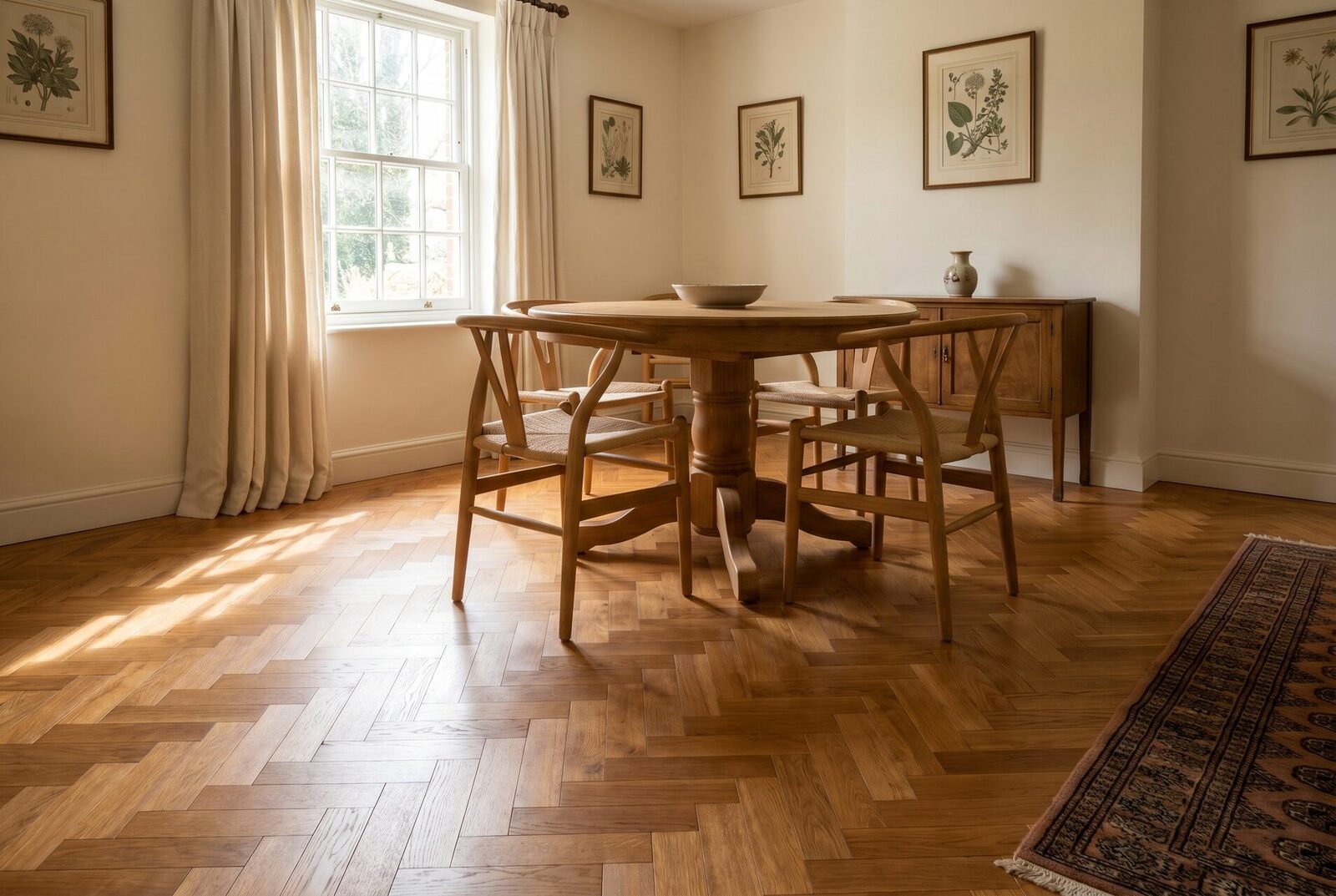
Most specified
Natural Oak — hardwax oil
The default brief and still the most-specified finish in the catchment. Untreated European white oak boards, brushed lightly to lift the grain, sealed with two coats of natural-tinted hardwax oil (Osmo Polyx oils or Bona finishes) hand-buffed between coats. Reads as the raw timber would on the day it was milled — warm honey under tungsten, pale champagne in daylight, no orange-cast, no plastic shine. The right call for kitchen-diners, hallways and any room where the floor should look like timber rather than a finish. Ages slowly to a deeper amber over years rather than yellowing within months like polyurethane.

Designer favourite
Smoked Oak
European white oak fumed in ammonia vapour at the mill before machining — the ammonia reacts with the tannins in the timber itself, darkening the wood right through its thickness rather than staining the surface. The result is a deep, characterful mid-brown that holds its colour at every sanding (because it's not surface stain, it's chemistry), with the grain figure showing through more strongly than on natural oak. We follow the smoking with a natural hardwax oil on site to seal without further colour-shift. The right pick for high-spec dining rooms, libraries, snugs and any space where the brief is 'rich and grounded' rather than 'light and Scandinavian'.
Statement
Fumed Oak — deep tone
A longer, deeper ammonia fume than smoked oak — taken further into the darkest mid-brown the species will sustain without losing the grain reading. Boards come back from the mill almost the colour of walnut but with the unmistakable oak grain showing through. Hand-finished on site with a natural hardwax oil. Specified where you want a near-black floor that doesn't read as artificially stained or laminate-printed — the colour is the timber's, not a topcoat's. The most common brief in dining rooms, formal libraries and statement entrance halls.
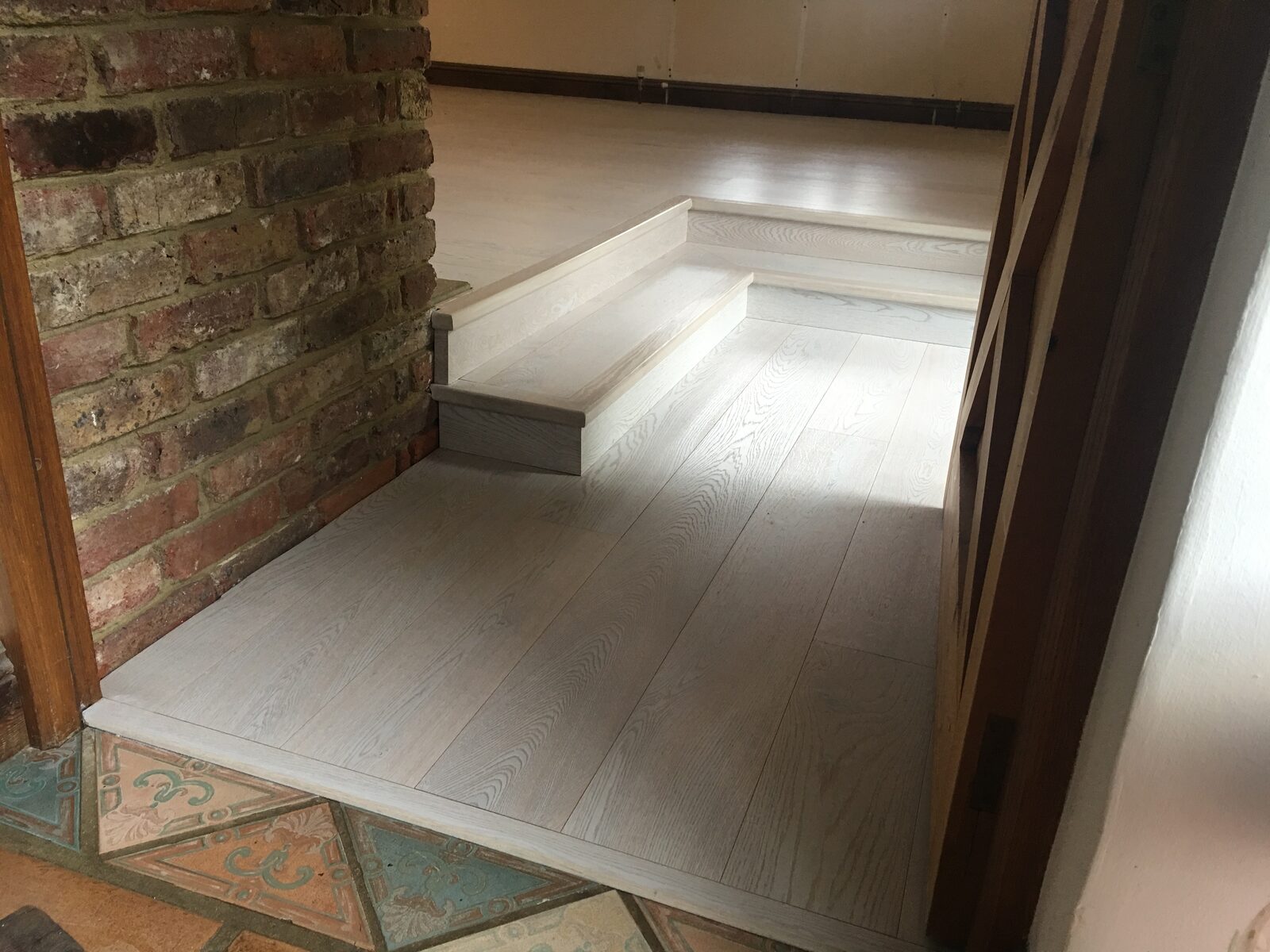
Light & airy
Limewashed Oak (Scandi)
Pale European oak finished with a white-pigmented hardwax oil that pushes the timber further toward a soft chalk-white reading without obscuring the grain. The brushing applied at mill stage opens the grain so the white pigment settles into the texture and reads as a chalked-board look rather than a paint. Two coats hand-buffed; the second one usually slightly diluted to preserve the warmth. The dominant brief for coastal extensions, North-facing rooms that need to lift, and any project where the kitchen palette is white-and-marble and the floor needs to disappear into the architecture rather than punctuate it.
Character
Brushed-and-Oiled Character Grade
European white oak character grade — meaning live knots, sapwood streaks, mineral marks and the natural variation that prime grade screens out. Heavily brushed to deepen the grain texture, then finished with a coloured hardwax oil (typically a slight grey-brown tint) hand-applied to settle into the brushed cavities. Reads as reclaimed-style without actually being reclaimed (which means consistent thickness, square edges, and engineered stability). The right brief for barn-conversions, country-house kitchens and any project where you want the floor to look lived-in from day one — the texture flatters dropped knives, dog claws and muddy boots in a way prime grade never will.
Why wide-plank European oak is worth it
True wide-plank European oak, or narrow boards with a wide-plank price tag?
Wide-plank oak — boards 220mm to 320mm wide, in 2–4m random lengths — is unmistakable in a room. There are two cheaper substitutes regularly sold against it: 180mm boards advertised as 'wide,' and 250mm planks veneered to 2mm. Both look right in a brochure. Neither holds up in person.
True wide-plank European oak (220–320mm)
Recommended-
Architectural-scale boards
A 280mm board in a 6m room is two-and-a-bit planks across. The eye reads the floor as continuous rather than busy — the entire reason the spec exists. Narrower 'wide-plank' loses this effect immediately.
-
Slow-grown European oak, properly graded
Mill stock from continental forestry with tight, even grain. We grade each pack on delivery and reject any board that doesn't pair with the rest — character grade or prime, the call is consistent across the room.
-
Real 18–20mm solid timber, or 6mm sawn-oak engineered
Either spec gives a 60–80 year service life with one or two refinish cycles. The wide format is what people pay for; the substrate spec is what makes it last.
-
Hand-finished on site
Brushed-and-oiled, limewashed, fumed, smoked — applied after install, hand-buffed between coats. Lets the floor settle to the room before the finish goes on. Factory-finished wide-plank locks you in to whatever the mill shipped.
-
Random lengths up to 2.5m+
Mixed-length packs we lay shortest-first to avoid a chequerboard joint line. A proper wide-plank floor has no two end-joints in line within three boards — the visual rhythm is half of why the spec works.
180mm 'wide-plank,' or 2mm veneer engineered
What you give up-
Narrow boards sold as wide
150–180mm planks are advertised as 'wide-plank' because they're wider than 100mm strip. They're not. In a room they read identically to standard floorboard — the architectural effect just isn't there.
-
2mm veneer on plywood
Cheap wide-format engineered with a 2mm slice of oak glued to ply. Can't be sanded — once it scratches, the room comes up. A 12-year floor sold at wide-plank prices.
-
Factory-finished, locked in
Sealed at the mill with UV lacquer — you live with whatever tone shipped. Can't be re-tinted, can't be re-oiled, can't be patched at a damaged edge without a visible joint.
-
Random lengths only on paper
Cheaper packs often ship 80% short-length boards (under 1m) with a few showroom-length pieces for the photos. The fitted floor reads chequerboard rather than continuous.
-
Open joints by year three
Under-spec'd solid wide-plank or poorly-acclimatised veneered stock cups and gaps within a couple of seasons. Once the lippage starts, the only fix is a full lift-and-relay.
A recent Haslemere project: 64m² of 260mm European oak character grade, brushed-and-oiled finish, hand-laid in random lengths over a screed substrate — £124/m². The 180mm 'wide-plank' UV-lacquered factory-finished alternative was £62/m². Same floor area, half the price, a quarter of the impact. The client picked the proper one and the room photographs for the website now.
How we run a wide-plank project
From aesthetic conversation to hand-finished floor.
Wide-plank oak lives or dies on the quality of the conversation before the order goes in — species grade, finish family, board width, random-length mix, batch matching, substrate spec. Get the survey right and the install runs predictably; get the survey wrong and a £15k floor reads £5k from the second the lights go on.
-
Aesthetic conversation & sample
Darren visits with full-size sample boards in 180mm, 220mm, 260mm and (where the design supports it) 300mm widths, in your three or four most likely finish families. We look at them on the floor in the actual room they're going in, under the actual lighting (natural daylight, evening tungsten, kitchen task LED) — never in a showroom and never under a single light source. Wide-plank oak reads differently at width than the small swatches a builders' merchant will hand you, and the finish reads dramatically differently from sample to in-situ — this is the conversation that locks down the spec.
-
Sourcing & batch confirmation
European white oak from one of three PEFC/FSC mills our suppliers have a direct relationship with — typically French (the finest grain consistency), Hungarian (the best value for prime grade), or Romanian (the strongest character grade selection). Our suppliers confirm grade (prime / rustic / character), wear-layer build (14/3mm or 20/6mm) and width specification with the mill, then batch-confirm — meaning the whole order is cut and selected from a single milling run so the grain, colour and figure read as a cohesive surface across the room. Batch-matching matters most on widths above 220mm where a colour or figure mismatch between deliveries is instantly visible.
-
Substrate & UFH spec review
Wide-plank engineered oak is unforgiving of a bad substrate — a 260mm board over a screed that's 5mm out of flat will rock visibly. Surface flatness check (≤3mm in 3m typically — tighter than narrower boards demand), screed moisture survey if you have UFH (≤3% concrete or ≤0.3% anhydrite on a Tramex CME4 meter, in line with BS 8203 practice), commissioning sign-off from the M&E contractor where present. We'll specify additional substrate prep — self-levelling skim, mechanical sand, or in extreme cases re-screed — where the substrate isn't where the boards need it.
-
Pre-lay checks & moisture logging
Engineered wide-plank oak doesn't require the formal acclimatisation window that solid hardwood needs — the cross-ply core is dimensionally stable, so there's no multi-week wait before laying can begin. What we do log before laying is a representative-board moisture reading alongside the screed or substrate reading — both go into the project file. Where UFH is present, we confirm the system has been running at a steady working flow temperature for at least 7 days before our survey; it stays on throughout the install rather than being switched off — switching off mid-install is a common mistake that changes the equilibrium conditions the boards have been checked against.
-
Full-spread glue-down install (UFH-compatible)
Boards laid into a full-spread bed of elastic PU adhesive (Wakol, Sika or Mapei) — no spot-gluing, no underlay-only floating. Random-length deployment from the pallet to keep the long boards visible across the centre of the room and the shorter offcuts at the perimeter where the eye lingers less. Expansion gap at every wall, hidden under the skirting. Skirting lifted before the floor goes in and reinstated after; never scribed-in around an installed skirting (which traps the floor against the wall and breaks the expansion provision).
-
Hand-applied finish — two or three coats
Finish family applied on site by hand, never factory-stamped. Natural and limewashed take two coats of hardwax oil with a buff between; smoked, fumed and character grades typically take three (the first being a sealing coat that lets the pigmented topcoat read evenly across grain density variation). Hand-buffed between coats with a 220-grit floor pad to keep the open-grain texture rather than polishing it flat. Final coat allowed to cure — light foot traffic after 12–18 hours, furniture back after 72 hours, the room in full use after about 7 days. Where UFH is present, the system stays at ambient flow until the finish has cured.
-
Handover with maintenance card
Final walkthrough with you in the room. Project file delivered — board batch numbers, finish data sheets, moisture readings, UFH commissioning log if applicable, before/after photos, care card covering the seasonal humidity range to aim for (40–60% RH ideally), pH-neutral cleaning regime, recoating cycle (typically a single refresh coat of hardwax oil every 5–7 years on hallways, 10+ years elsewhere) and what to do if anything ever marks. 12-month defect liability from practical completion.
Recent wide-plank engineered oak flooring work
A few of our wide-plank engineered oak flooring projects.
Real homes where this work has just gone in — across Sussex, Surrey and Hampshire.
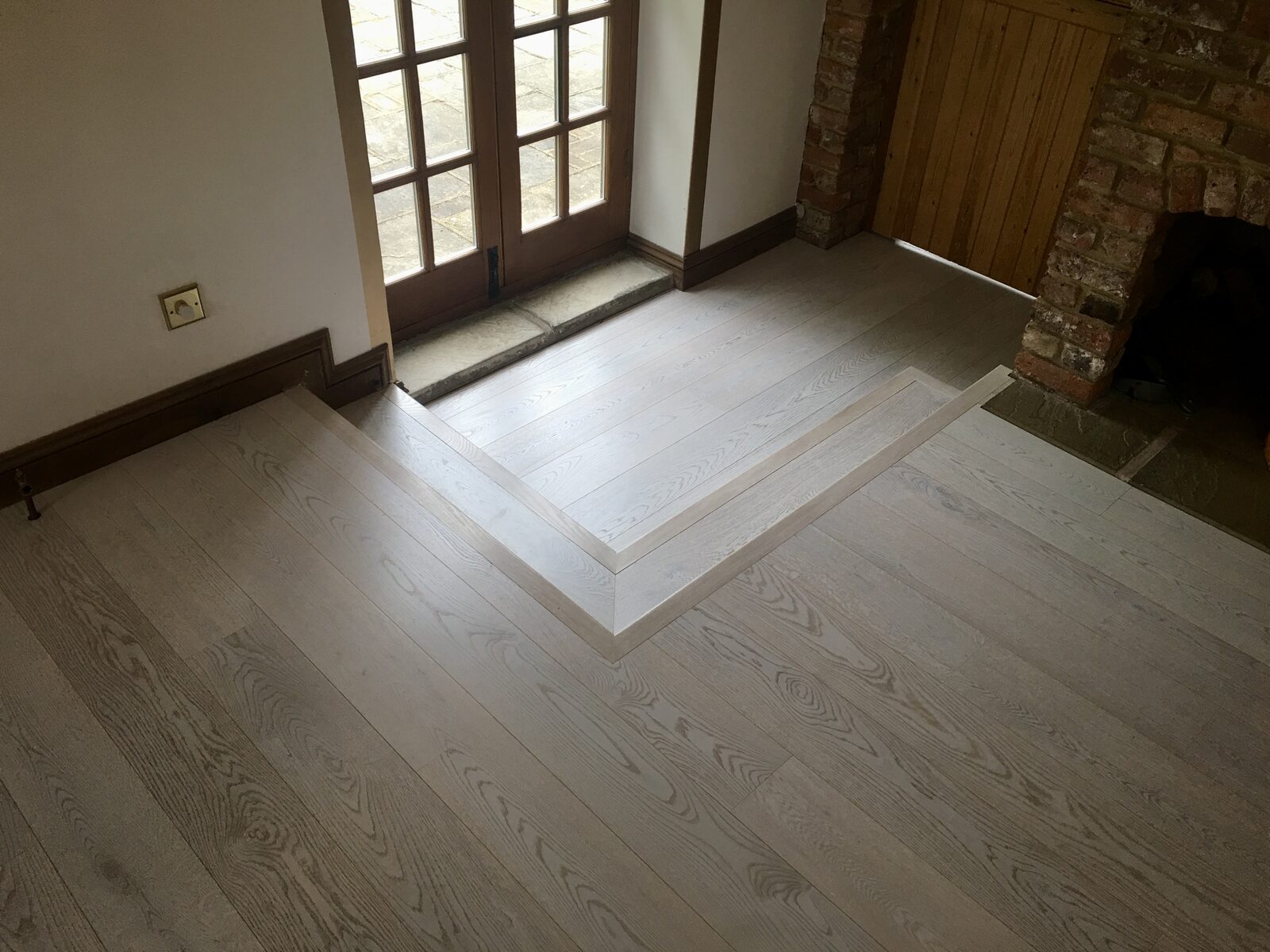
Chichester, PO19
Limed pale oak wide boards
The kind of pale wide-plank floor we’d lay in a Chichester home — limed oak boards in a cool whitewashed grey-blonde tone, run as wide planks with a neat stepped border by the French doors and finished in a matt oil that keeps the look soft and chalky.
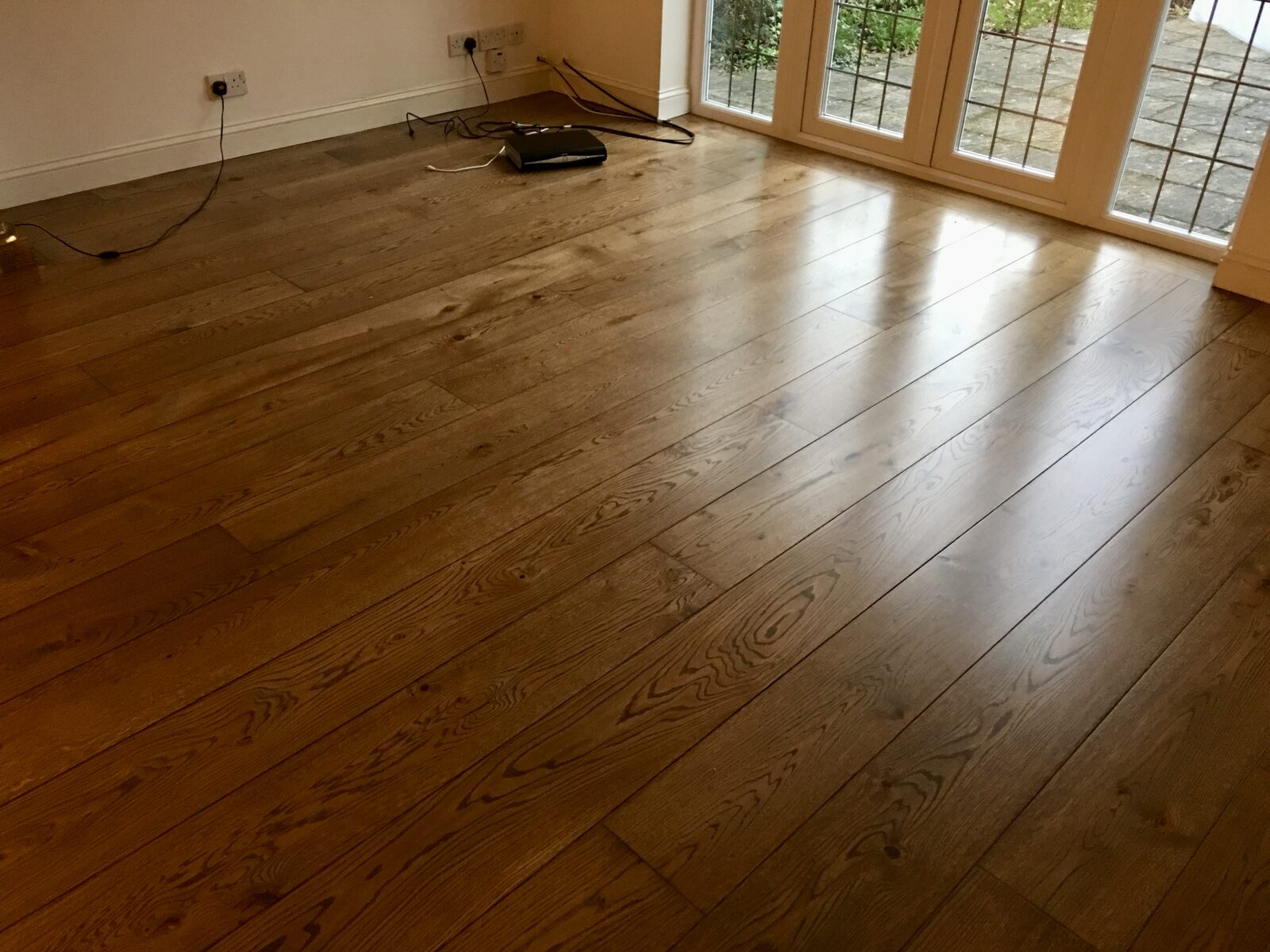
Petersfield area, GU31
Warm mid-brown oak wide boards
The kind of warm wide-plank floor we’d lay in the Petersfield area — mid-brown oak boards with plenty of knot and grain character, run in long lengths toward the garden doors and finished in a higher-sheen lacquer that gives the timber a rich, mellow glow.
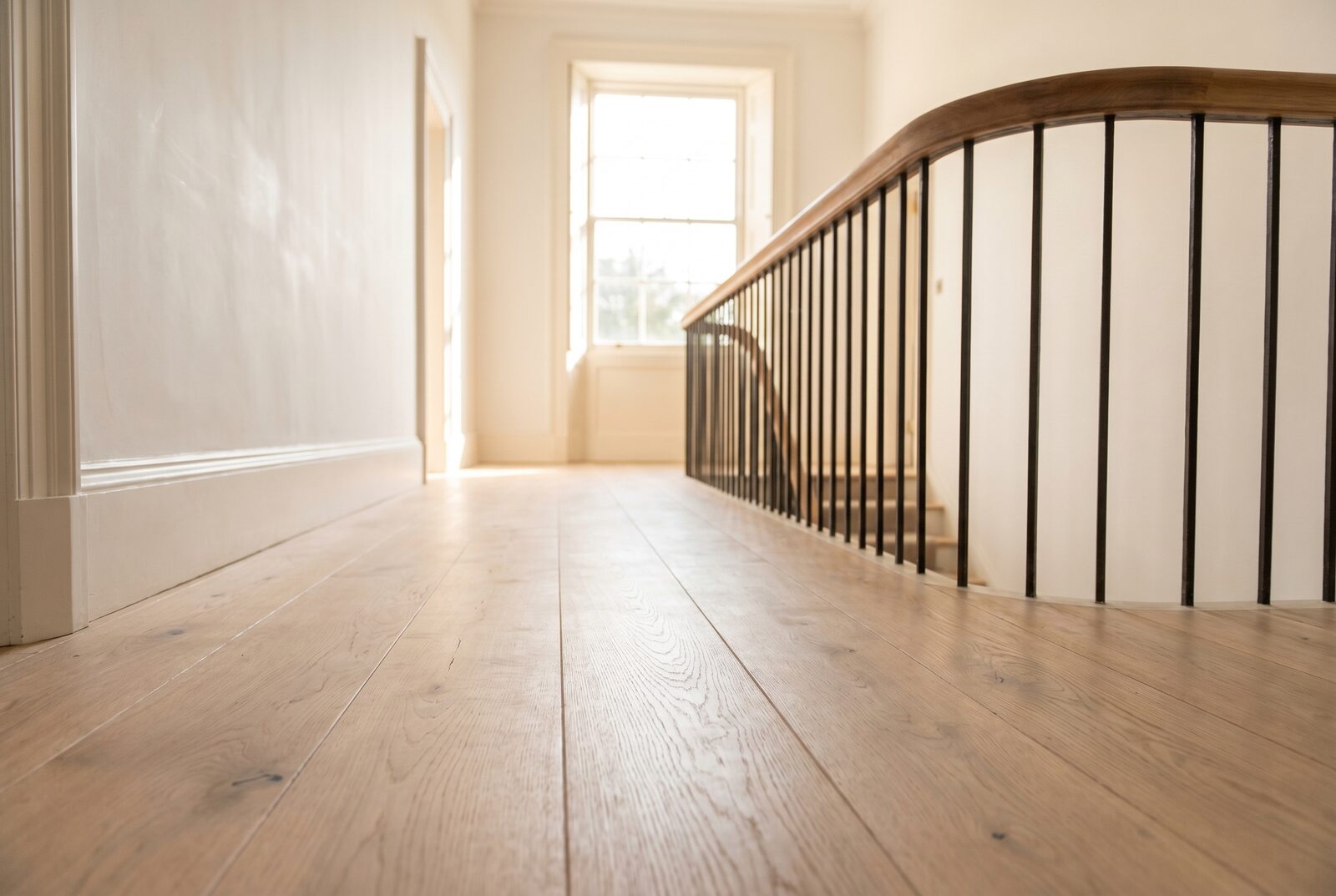
Arundel, BN18
Pale oak boards, curved landing
The kind of pale wide-plank floor we’d lay in an Arundel home — natural blonde oak boards run in long lengths across a bright landing and sweeping round a curved staircase, finished in a low-sheen oil that keeps the tone light and lets the soft grain show.
Room by room
Wide-plank oak flooring for every room in the house.
Where you’re laying it changes what we recommend. Here’s how we approach wide-plank oak flooring in each room of a home.
Wide-plank oak flooring for kitchens
The busiest floor in the house — spills, dropped pans and constant footfall. We spec hard-wearing boards and a tough, wipeable finish that shrugs off splashes around the sink and hob.
Wide-plank oak flooring for bathrooms
Moisture is the enemy here, so we lean toward engineered constructions and water-resistant finishes — warm wood underfoot without the swelling and cupping that catches solid boards out.
Wide-plank oak flooring for hallways
First impression and highest traffic in one. Durable, scuff-resistant boards run wall-to-wall to draw the eye through the house and take the daily pounding of muddy boots and the front door.
Wide-plank oak flooring for living rooms
The room you actually live in. Wider, character-grade boards make the space feel calm and considered, with a satin finish that's warm to walk on of an evening.
Wide-plank oak flooring for bedrooms
Quiet, warm and easy on bare feet first thing. We fit over acoustic underlay upstairs and finish with a low-sheen oil that keeps the room restful.
Wide-plank oak flooring for stairs
The hardest-working timber in the house and the trickiest to fit. Bullnosed treads, matched risers and a non-slip finish, scribed to the existing strings for a seamless run.
Wide-Plank Engineered Oak Flooring across the region
Wide-Plank Engineered Oak Flooring from Chichester to Lindfield & Cuckfield.
Wide-Plank Engineered Oak Flooring is the bread and butter of the workshop. You’ll see our van rolling out of Bognor Regis most weeks toward Chichester, Haslemere, Petersfield, Midhurst, Arundel, Petworth, Emsworth and Lindfield & Cuckfield — the postcodes across Sussex, Surrey & Hampshire where wide-plank engineered oak flooring keeps the diary full. European white oak in plank widths from 180mm up to 300mm+, random lengths to 2.5m, hand-finished on site — natural, smoked, fumed, limewashed or brushed-and-oiled character grade.
Whether the brief is a Georgian terrace in Chichester, a 1930s semi out near Haslemere, or a converted barn off the lanes around Lindfield & Cuckfield, the spec and the standard don’t shift. Darren surveys on-site, sample boards stay with you for a fortnight under your own lighting, and the install runs in a single solid stretch — no day-trip back-and-forth, no chain of phone numbers, flat-rate quotes by the job not the mile. Family team since 1997, covering Sussex, Surrey & Hampshire from the same coastal base.
“Had a large wood engineered floor laid. Absolute brilliant service from initial enquiry to completion. Could not rate highly enough. Would have no hesitations in recommending them to anyone! Really good finish and reasonably priced.”
Read this on Google
Frequently asked
Questions about wide-plank engineered oak flooring.
What's the maximum plank width you can do?
300mm in European white oak as a standard engineered build, 14/3mm or 21/6mm. We can occasionally source 320–340mm on direct mill-cut orders for premium new-build projects, but the lead time stretches considerably (8–12 weeks) and the price-per-square-metre jumps by 30–50%. For 90%+ of briefs the sweet spot is 220mm or 260mm — wide enough to read genuinely as wide-plank, narrow enough to deliver from standard mill stock at a sensible lead time. We'll show you 180, 220, 260 and 300mm samples at survey so the width decision is made in the room not on a spec sheet.
Can I have solid wood at these widths?
Honestly, no — we'll politely refuse to install solid hardwood at widths above 180mm, full stop. Solid wood moves proportionally to its width across the seasonal humidity swing, so a 260mm solid board will cup, crack and gap visibly within the first heating cycle of a UK home, regardless of how good the installer is. The physics doesn't care about price point. Engineered construction with a real-oak top layer is what makes wide-plank widths possible — and once installed and finished, an engineered floor is visually indistinguishable from solid (same species, same grain, same hand-applied finish, same sandability with a 6mm wear layer). For 130–180mm widths solid is back on the table — see our hardwood flooring page for that conversation.
Where does the oak come from?
European white oak from PEFC/FSC-certified mills in three sources — French oak (the finest grain consistency, the highest premium, the standard call for prime-grade specifications), Hungarian oak (the best value for prime grade with very strong consistency, our default for most residential briefs), and Romanian oak (the strongest character-grade selection where the brief wants knots, sapwood and texture). All three are sustainably managed under European forestry standards. Our suppliers work direct with the mills rather than through a UK distributor, which is why we can batch-confirm against the actual milling run rather than picking from whatever the warehouse has in stock.
How long are the random-length boards?
Random-length deliveries we accept run from 400mm at the shortest to 2.5m+ at the longest, with 80%+ of boards over 1.2m. Where the brief is the country-house long-board look we'll batch-confirm a longer-length mix (1.5m minimum, with regular 2.0–2.5m pieces) — this stretches the lead time and adds a small premium but the visual difference across a kitchen-diner is significant. Standard wide-plank stock from most distributors averages 1.0–1.2m which reads markedly more 'patchwork' than a longer-length mill cut.
Will wide-plank oak work over my underfloor heating?
Yes — wide-plank European oak in an engineered build is one of the most-specified UFH floor types in the catchment. The engineered cross-ply core handles the temperature cycling that wet UFH puts on the floor, and the wider boards transfer heat into the room as effectively as narrower ones (provided the install is full-spread PU adhesive, not floating-on-underlay which adds thermal resistance). The proviso is that the substrate has to be commissioned properly — screed moisture surveyed to BS 8203, heat-on/heat-off cycle complete, written commissioning log signed off. See our underfloor heating compatible wood floors page for the full UFH specification we run as standard.
What's the lead time on a wide-plank order?
Prime-grade European oak from stock in standard widths (180mm, 220mm): typically 3–5 weeks from survey to delivery. 260mm wide-plank with batch-confirmation: 5–7 weeks. 300mm wide-plank or longer-length mill cut: 8–12 weeks. Add 1–2 weeks for ammonia-fumed (smoked or fumed) batches, which need to be fumed at the mill before machining. We'll set realistic lead-time expectations at survey rather than promising fast turnarounds we can't keep — wide-plank oak is not a same-week stock item from anywhere reputable.
What's the difference between prime, rustic and character grades?
Grade is the timber selection criteria applied at the mill before machining. Prime grade: small or no knots, minimal sapwood, consistent colour and grain — the cleanest reading, the most expensive, the typical brief for designer-led extensions and high-end new-builds. Rustic grade: live knots and minor sapwood permitted, more grain variation, the most-specified mid-range brief — looks 'like timber' rather than like a perfectly screened sample. Character grade: large live knots, sapwood streaks, mineral marks, the most variation — perfect for barn conversions, country kitchens and any project where the floor should look lived-in from day one. The price spread top-to-bottom is roughly 2:1; the visual difference is enormous. We bring samples of all three at survey.
How do I look after a hardwax-oil wide-plank floor?
Soft-broom or vacuum (brush attachment, not turbo head) two or three times a week. Damp-mop with pH-neutral hardwax-oil cleaner (Osmo Wash & Care or Bona Hardwax-Oil Cleaner) — the bottle costs about £20 and lasts a year. Never steam-clean (steam destroys hardwax oil) and never use a generic all-purpose floor cleaner (the detergent strips the oil). Address spills within a few minutes; water itself is fine, red wine left overnight isn't. Every 5–7 years on a hallway (10+ elsewhere) we recommend a single refresh coat of hardwax oil — Darren can do this in a couple of hours per room, no sanding, no disruption. With that care a wide-plank engineered floor at 14/3mm should be looking great at 20–25 years; at 21/6mm at 35–40.
Ready to start?
Talk to Darren direct
07973 658149
Mon–Fri, 8am–6pm
Get a free survey for your wide-plank engineered oak flooring.
Darren will visit, measure up and walk you through species, finishes and lead times. No pressure, no hard sell — just specialist advice.