
Reclaimed & Antique
Reclaimed wood floors — sourced, acclimatised, laid with respect to age.
Genuinely antique timber — French oak, period pitch pine, reclaimed oak parquet and other salvaged hardwoods — sourced with provenance, acclimatised on site, then laid in mixed widths and finished in hardwax oil so the patina has somewhere to keep going.
Sussex · Hampshire · Surrey · French oak · pitch pine · reclaimed oak parquet · teak · mahogany · iroko
29
years on the tools
5.0
★ · 215 reviews
About reclaimed & antique wood flooring
Reclaimed isn't a finish — it's a provenance.
Walk into a high-street showroom and ask for "reclaimed-look" oak and they'll sell you an engineered board with a laser-etched distress pattern, a baked-on grey tone, and a 0.5mm wear layer that will go through to the plywood after one decent sand. It looks like reclaimed in a magazine photo and looks like a fake the moment the morning sun hits it. Genuine reclaimed timber is something else entirely — it has a history (the French barn it stood in for two hundred years, the Edwardian flax mill it was the ceiling joist of, the Victorian gentleman's club it was the dance floor of), a patina that no factory chemistry can replicate, and a density that only comes from a century or more of slow seasonal movement. You can feel the difference under bare feet. You can certainly tell the difference at the threshold strip where reclaimed meets new build.
We've been working timber floors across Sussex, Hampshire and Surrey since 1997, and reclaimed has quietly become one of the most rewarding briefs we take on — country-house owners restoring a hall, country-pub fit-outs that want the floor to look like it was always there, barn-conversion homeowners who fell for the building because it had character and don't want a new-build floor undoing that, designers and architects specifying for a Goodwood or Cowdray-corridor project where the brand demands the real thing. The work is half-sourcing, half-craft. Darren has the relationships to find the right stock for the project — French oak from suppliers who can tell you which farm, period pitch pine that started life as Edwardian flooring elsewhere, original oak parquet lifted from inter-war public buildings, and reclaimed hardwoods like teak, mahogany and iroko sourced to order. And once the boards reach site, the timber is acclimatised in the room it will be laid in for 7–10 days before we lay a board — that conditioning is what separates a floor that lasts from one that cups in the first winter.
Sourcing network — French oak, pitch pine, reclaimed oak parquet, plus teak, mahogany, merbau, iroko and sapele to order
Honest grading at the yard — genuine antique provenance, not distressed-modern fakes
Acclimatised on site for 7–10 days so the timber settles to your home before a board is laid
Mixed-width install where the boards demand it — laid as a pattern, never as a mistake
Hardwax oil over the patina — never a high-build lacquer that buries the character
Sympathetic gap-filling — board-matched slivers and resin, no modern flexible filler
Most asked for
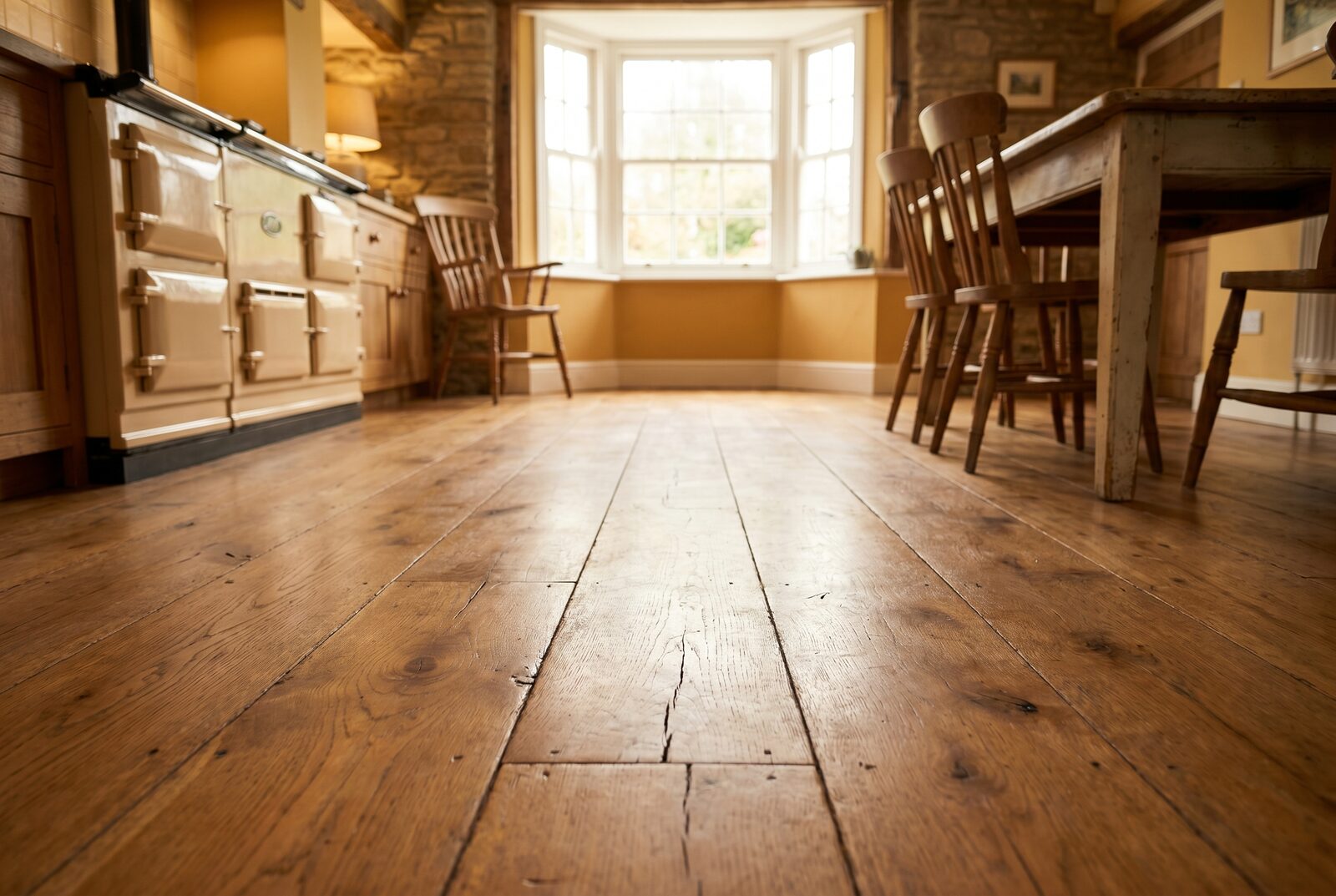
French Oak
Two-to-four-hundred-year-old European oak lifted from French barns, granaries and farmhouses — typically wide planks (180–300mm), nail-holed, soft-edged, with the deep nutty brown of timber that has been slowly oxidising in a hayloft for a couple of centuries. The boards arrive with their saw-marks and patina intact. Laid in random widths and finished in a clear hardwax oil, this is the floor that makes a Sussex country-house look like it has always had it. Most often specified in halls, dining rooms, lounges and country-kitchen schemes.
Period-correct
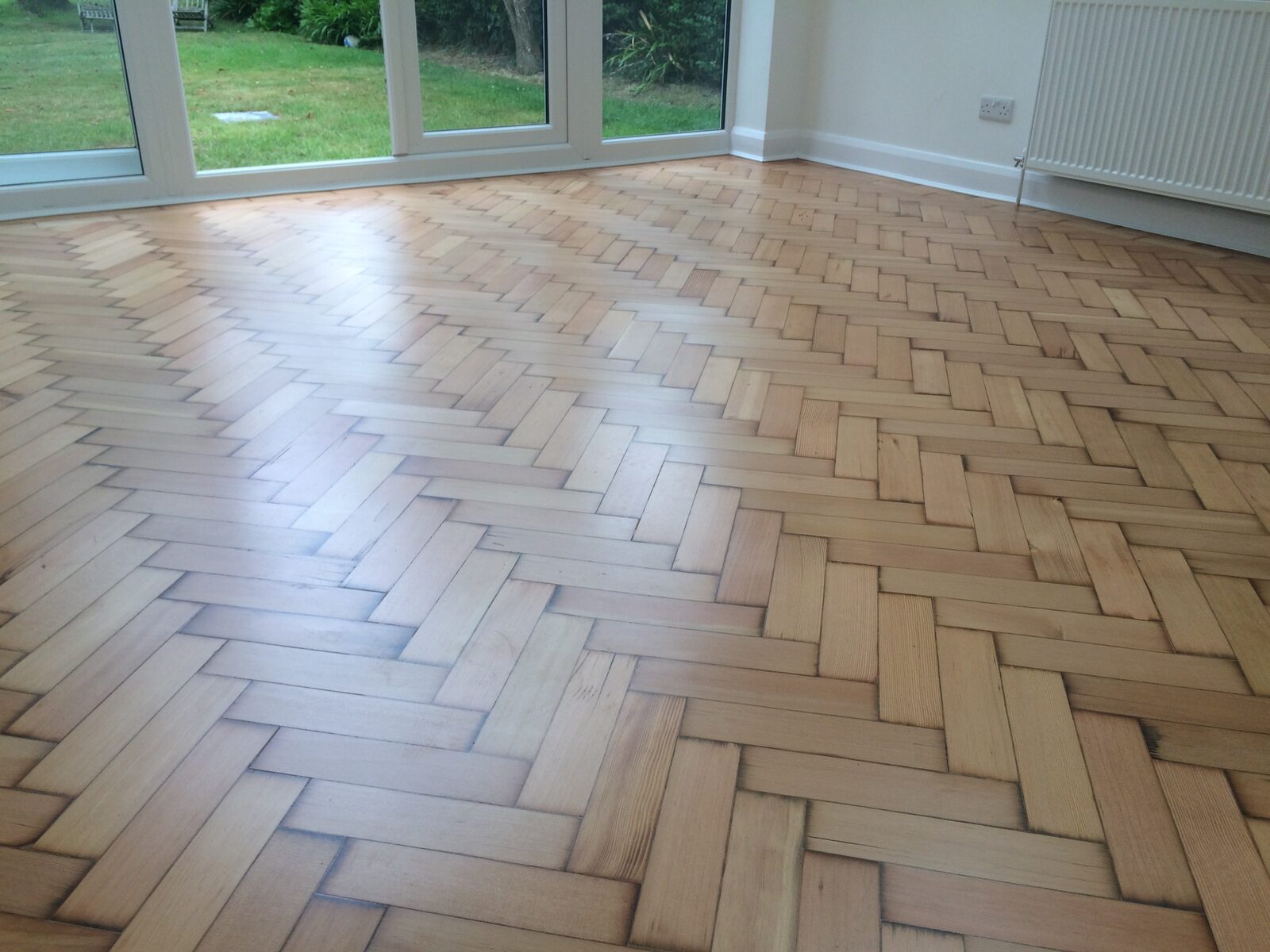
Pitch Pine
Pitch pine was the Edwardian and late-Victorian flooring of choice — dense, resinous, naturally hard-wearing, and warm-amber in colour. Genuinely antique stock comes from the lift-and-replace projects we and others do on period houses, schools, churches and railway buildings across the South. We hold a working stock in board widths from 100mm through to 250mm, in lengths up to 4m, with the patina from a hundred years of beeswax polish intact on the show face. Laid in a period property it's invisible; laid in a contemporary barn conversion it's a feature. Hardwax oil only — pitch pine resin sits proud of any lacquer film and turns it yellow within five years.

Sourced to order
Reclaimed Hardwoods
Beyond oak and pine we source a range of reclaimed and antique hardwoods to order — teak, mahogany, merbau, iroko and sapele. These denser tropical and European species turn up as salvaged stock from refurbishments, deconstruction and architectural-salvage yards, and suit a project that wants a darker, richer floor than oak with the same genuine age behind it. Availability depends on what the salvage market is holding at the time, so these are a sourcing conversation rather than an off-the-shelf order — tell us the look you're after and we'll come back with what we can place and a realistic lead time.
Geometric reclaimed
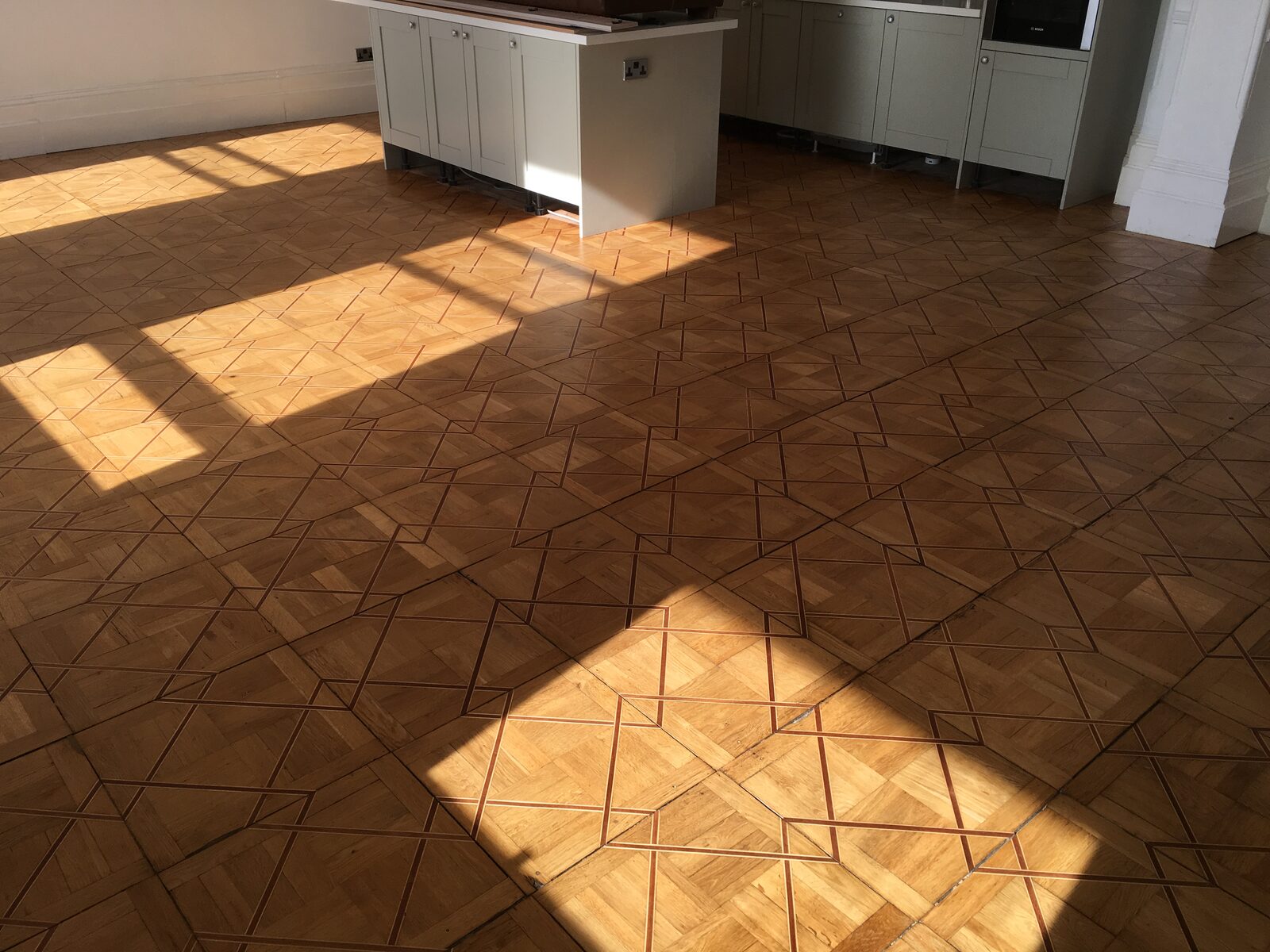
Reclaimed Parquet Blocks
Original 1920s–1950s oak parquet blocks lifted from school halls, town halls and inter-war public buildings — usually 70 × 230mm or 90 × 280mm, with the tongue-and-groove still intact and the bitumen base scraped clean. We re-bed in modern bitumen-free adhesive, hand-pattern the layout (herringbone, chevron, or basket-weave to suit the building's age and the homeowner's eye), full three-pass sand, then finish in clear hardwax oil. The result is a geometric floor that reads as a hundred years old because it is. For an extended treatment of parquet patterns and species options see our parquet and herringbone page.
Why genuine reclaimed is worth it
Genuinely old timber, or factory-distressed new boards?
Most 'antique-effect' flooring sold today is brand-new oak that's been brushed, stained and scuffed at the factory to look aged. It doesn't. Here's why the real thing — boards with a hundred years of history in them — is worth waiting for.
Genuine reclaimed timber
Recommended-
Real patina built up over decades
Saw marks, peg holes, surface darkening, edge wear — laid down by a hundred years of use. The eye reads it as truthful in a way no factory finish ever achieves.
-
Provenance you can name
We source from named buildings — Victorian schools, French chateaux, ex-MOD pitch pine warehouses. Most clients want to know where their floor came from. We can tell them.
-
Denser, harder, more stable
Old-growth timber was milled from slow-grown trees with tight grain density modern fast-grown stock can't match. The boards are physically harder and more dimensionally stable than new-cut equivalents.
-
The sustainable choice
Carbon already sequestered, no fresh felling. Reclaimed is the lowest-impact hardwood floor you can specify — often the deciding factor on listed-building and eco-build briefs.
-
Appreciates rather than depreciates
Genuine reclaimed timber gets harder to source year by year. Floors we lay now are worth more in five years than they cost to install. New stock never appreciates.
Factory-distressed new boards
What you give up-
Identical 'character' on every board
The same wire-brushing pattern, the same stain spots, the same 'aged' bevel — repeated across the pack. The repeat shows up across a room within weeks.
-
Soft, fast-grown timber
Modern plantation oak grows in 40 years what reclaimed took 150. The grain is wider, the fibre softer, the board dents and scratches more easily despite the rustic finish.
-
No story to tell
When guests ask where the floor came from, the honest answer is 'a mill last year, distressed at the factory.' That's not a story; it's a sourcing receipt.
-
Aged finish wears off
Factory stains and patinas live on the surface and sand off in one refinish. After the first 10-year refresh you're left with a plain new-oak floor pretending to be neither one thing nor the other.
-
Higher footprint, lower legacy
Fresh fell + factory finishing + shipping. Compared with already-cut, already-cured, already-storied reclaimed timber a few miles away.
Reclaimed is slower and slightly dearer to source — typically a four-to-eight-week lead from yard to lay — but once it's down it doesn't date, doesn't fall out of fashion, and doesn't need to be replaced. The most-photographed Forrestal floors are all reclaimed.
How we work reclaimed
From brief, to yard, to finished floor.
Reclaimed adds two stages a new-timber floor doesn't need — the sourcing conversation up front and the on-site acclimatisation before the boards are laid. Get those right and the install is the easy part.
-
Brief & aesthetic conversation
Reclaimed is the most personal floor we lay, and the brief is half the work. We'll come out, sit with the room, talk about the buildings that have informed your eye, look at what colour the walls want to talk to, and put a rough species and origin shortlist together. Country-house schemes usually point at French oak; barn conversions and period homes often want pitch pine; geometric schemes want reclaimed parquet, and a darker brief might call for reclaimed teak or mahogany. We'll come back with three options, not thirty.
-
Sourcing & sample
Once the species is decided we'll source physical sample boards from the supplier — same farm or same building where we can — and walk you through them at your kitchen table. You see the actual width, the actual patina, the actual nail-hole density. Reclaimed is sold by the lift, not by the square metre as a uniform product; the stock you commit to is the stock you get. We'll show you photographs of the yard, and where the project size demands it we'll take you to the yard to walk the stack.
-
Delivery & on-site acclimatisation
Genuinely antique timber needs to settle to its new home before it's laid. Once the boards reach site we stack them in the room they'll be installed in and leave them to acclimatise for 7–10 days, so the timber reaches the home's temperature and humidity before a single board is fixed down. Skip that step and reclaimed earns its undeserved reputation for cupping in the first winter of central heating; give it the acclimatisation time and the floor has nowhere left to move.
-
Mixed-width install
Reclaimed rarely comes in a uniform width — the lift you bought might run from 180 to 280mm across the same parcel. A new-wood crew will reach for the table saw to rip everything to a single width; a reclaimed-aware fitter lays the boards as a deliberate mixed-width pattern, alternating widths board-by-board down the run so the floor reads as a deliberate design choice rather than a sourcing accident. We pre-lay the entire room dry before nailing down so the pattern is balanced under the eye-line, then secret-nail or glue-down to suit your subfloor.
-
Hardwax oil finish — over the patina, not under it
Reclaimed timber almost always wants hardwax oil and almost never wants a high-build lacquer. The reason is the patina: a hundred years of beeswax, sun, and slow oxidation has given the show face a surface character that a polyurethane film instantly flattens. Hardwax oil sinks into the wood, leaves the patina on top, and lets the floor keep ageing the way it has been for a century. We hand-buff to a soft satin sheen — a slightly higher gloss than period work would have had originally, but in line with how a Sussex homeowner wants the floor to read today.
-
Maintenance card & touch-up kit
Walkthrough with a written care card listing the exact products used (hardwax oil brand, soap concentrate for routine cleaning, touch-up oil for the inevitable wine spill), the cure schedule, and the recommended re-coat cycle — typically 7–10 years for a hardwax-oiled reclaimed floor in domestic use, sooner in a country-pub or commercial setting. Touch-up kit supplied with a small jar of the oil and a felt applicator. We're a phone call away if anything ever comes up.
Recent reclaimed & antique wood flooring work
A few of our reclaimed & antique wood flooring projects.
Real homes where this work has just gone in — across Sussex, Surrey and Hampshire.
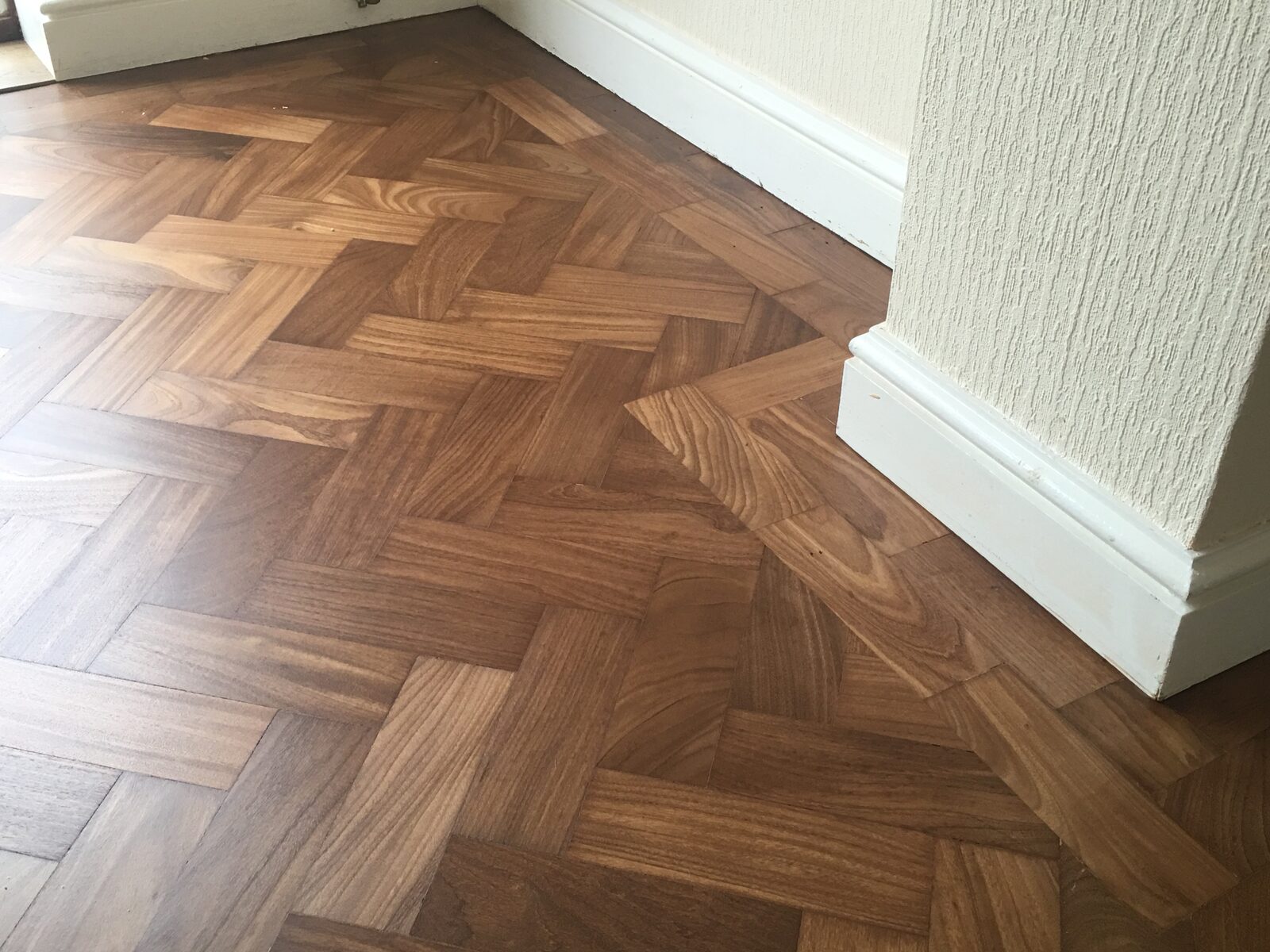
Chichester, PO19
Honey-amber herringbone parquet
Warm honey-amber parquet blocks laid in a tight herringbone against a textured wall - clear, even grain in a mellow golden tone, finished in a soft satin oil that catches the light. The kind of reclaimed-timber parquet we’d re-lay and revive in Chichester.

Steyning, BN44
Reclaimed blocks, mid-install
Reclaimed parquet blocks part-way through laying - weathered timber in mixed pink, grey and brown tones set out in herringbone across a bare concrete subfloor, not yet sanded or finished. The kind of salvaged floor we’d lift, sort and re-lay before bringing it back to life in Steyning.
Midhurst, GU29
Mid-brown oak herringbone parquet
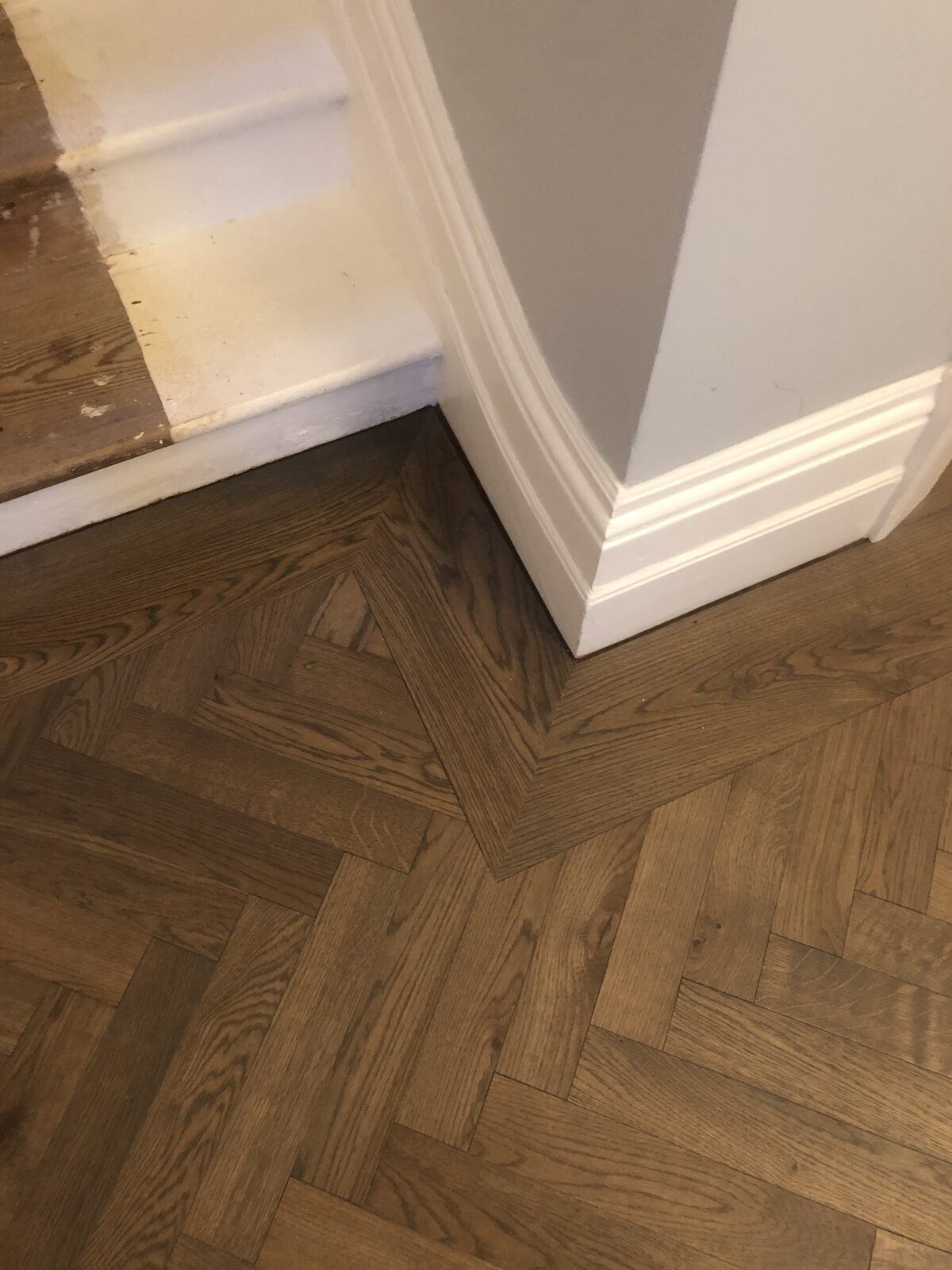
Mid-brown oak herringbone with a plain-block border, swept around a curved wall by a staircase still mid-restoration above - straight, even grain finished in a low-sheen oil. The kind of period parquet and stair we’d take back and refinish together in Midhurst.
Lindfield, RH16
Pale oak herringbone with border
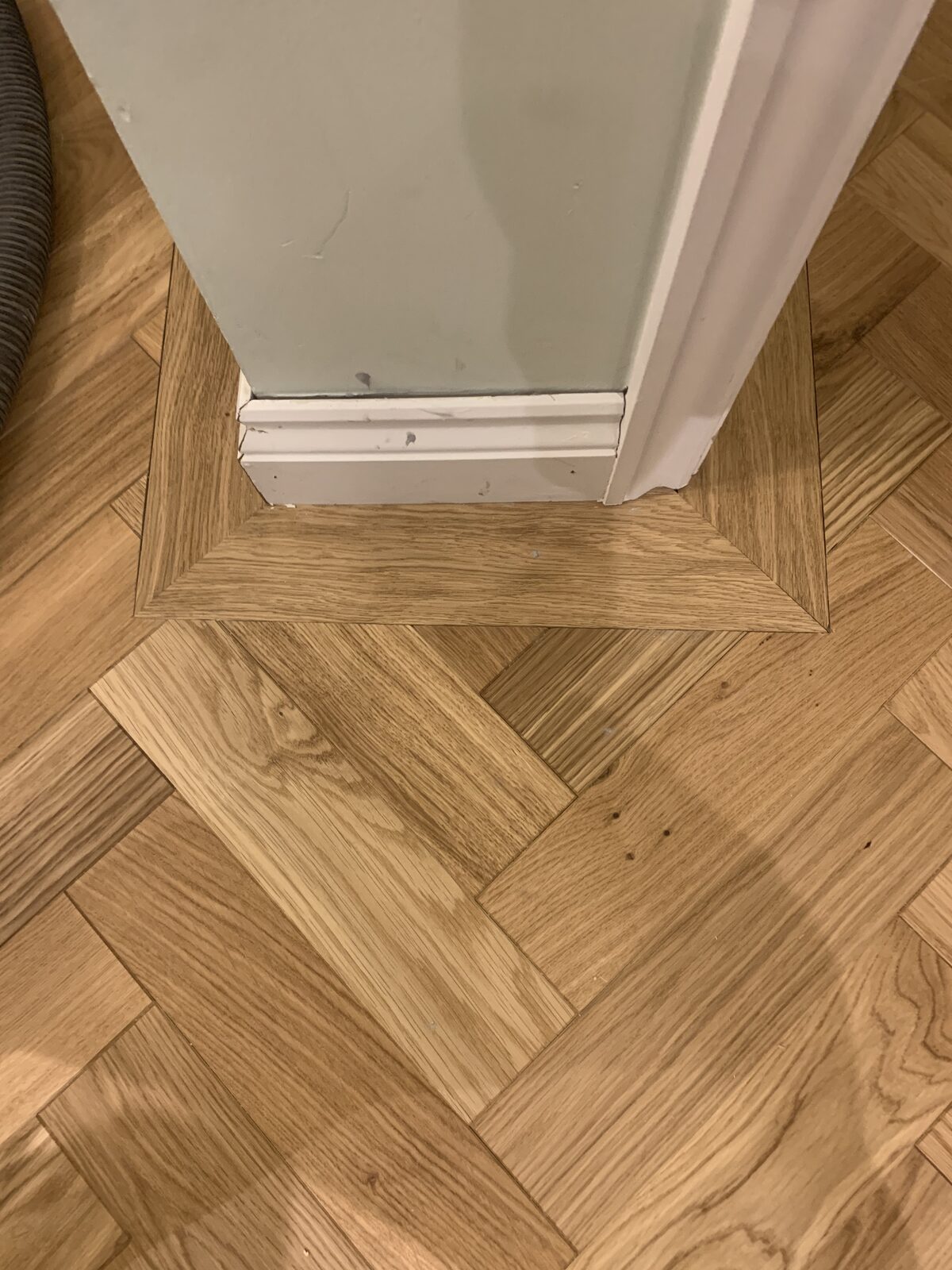
Pale natural oak herringbone framed with a plain-block border around a corner pier - light blond timber with gentle grain, finished in a soft matt oil that keeps the tone bright. The kind of reclaimed-oak parquet we’d re-lay and finish in a Lindfield home.
Room by room
Reclaimed wood flooring for every room in the house.
Where you’re laying it changes what we recommend. Here’s how we approach reclaimed wood flooring in each room of a home.
Reclaimed wood flooring for kitchens
The busiest floor in the house — spills, dropped pans and constant footfall. We spec hard-wearing boards and a tough, wipeable finish that shrugs off splashes around the sink and hob.
Reclaimed wood flooring for bathrooms
Moisture is the enemy here, so we lean toward engineered constructions and water-resistant finishes — warm wood underfoot without the swelling and cupping that catches solid boards out.
Reclaimed wood flooring for hallways
First impression and highest traffic in one. Durable, scuff-resistant boards run wall-to-wall to draw the eye through the house and take the daily pounding of muddy boots and the front door.
Reclaimed wood flooring for living rooms
The room you actually live in. Wider, character-grade boards make the space feel calm and considered, with a satin finish that's warm to walk on of an evening.
Reclaimed wood flooring for bedrooms
Quiet, warm and easy on bare feet first thing. We fit over acoustic underlay upstairs and finish with a low-sheen oil that keeps the room restful.
Reclaimed wood flooring for stairs
The hardest-working timber in the house and the trickiest to fit. Bullnosed treads, matched risers and a non-slip finish, scribed to the existing strings for a seamless run.
Reclaimed & Antique Wood Flooring across the region
Reclaimed & Antique Wood Flooring from Chichester to Lindfield & Cuckfield.
Reclaimed & Antique Wood Flooring is the bread and butter of the workshop. You’ll see our van rolling out of Bognor Regis most weeks toward Chichester, Haslemere, Petersfield, Midhurst, Arundel, Petworth, Pulborough & Storrington, Steyning and Lindfield & Cuckfield — the postcodes across Sussex, Surrey & Hampshire where reclaimed & antique wood flooring keeps the diary full. Genuinely antique boards — French oak, pitch pine, reclaimed oak parquet, plus teak, mahogany, merbau, iroko and sapele to order — sourced with provenance, acclimatised on site, laid with respect to age.
Whether the brief is a Georgian terrace in Chichester, a 1930s semi out near Haslemere, or a converted barn off the lanes around Lindfield & Cuckfield, the spec and the standard don’t shift. Darren surveys on-site, sample boards stay with you for a fortnight under your own lighting, and the install runs in a single solid stretch — no day-trip back-and-forth, no chain of phone numbers, flat-rate quotes by the job not the mile. Family team since 1997, covering Sussex, Surrey & Hampshire from the same coastal base.
“Amazing floor repair and sanding .. excellent workmanship and fair and transparent price .. really please with the restoration of our very old cottage floor and would highly recommend Darren's work and communication … thank you”
Read this on Google
Frequently asked
Questions about reclaimed & antique wood flooring.
Is reclaimed wood really worth the extra over new oak?
For some projects yes, for some projects no — and we'll tell you honestly at survey. The case for reclaimed: genuine patina that no new wood ever matches; species you can no longer buy new (genuinely old-growth pitch pine, dense slow-grown oak); a story that adds to the building rather than fighting it; and a floor that's already done its seasonal-movement settling so it's actually more stable in a centrally-heated home than new oak. The case against: per-square-metre cost is typically 1.5–2.5× new European oak; lead times run 3–6 weeks for sourcing; you commit to the actual boards in the actual lift, not to a catalogue spec. If the project wants reclaimed for the right reasons, the maths is worth it. If the project wants reclaimed because it's fashionable, a good-quality character-grade new oak with a hand-applied finish often reads better and costs half.
How do I know your reclaimed stock is genuinely antique and not distressed modern?
Three tells we look for at the yard, and one we'll show you on a sample board. First, nail-hole pattern — genuine antique boards have cut-nail holes (square-section) clustered along the joist lines of the original building, not the round wire-nail holes of modern production. Second, growth-ring density — pre-1930s timber is slow-grown and has 12–25 rings per inch of grain; modern plantation timber has 4–8. Third, end-grain oxidation — a board that's been in a barn for 200 years has oxidised right through to the heartwood and shows that on a fresh end-cut. Distressed-modern fakes pass none of these tests. We'll cut a sample board end on-site at the survey and walk you through what you're looking at — the difference is obvious once you've seen it once.
Will reclaimed wood move or cup in my centrally-heated home?
Not if it's given time to acclimatise before it's laid. The reason badly-handled reclaimed gets a reputation for cupping is that it's rushed straight onto the subfloor and then loses moisture over the first winter of central heating. We deliver the timber to site and leave it to acclimatise in the room it will be laid in for 7–10 days before we lay a board, so it reaches your home's temperature and humidity before it's fixed down. Reclaimed timber is actually more dimensionally stable than new wood once it's settled — two centuries of seasonal movement gets you a floor that doesn't move any more.
Can you do mixed widths without it looking accidental?
Yes — and a good mixed-width install is the single most beautiful thing about a reclaimed floor. The technique is to pre-lay the entire room dry before nailing, balance the widths under the eye-line so the heaviest boards anchor the room's sight-lines, and alternate widths board-by-board down each run rather than running all the wide boards together. Done right, the floor reads as a deliberate pattern that respects the timber's reality. Done wrong (random widths shoved together with no thought to placement), it reads as someone couldn't be bothered to rip the boards to a single size. We dry-lay every reclaimed install and walk it with you before a single nail goes in.
Why hardwax oil and not lacquer on a reclaimed floor?
Two reasons. First, the patina — a polyurethane lacquer is a film that sits on top of the wood. Brush it over a reclaimed board and you've just put a sheet of clear plastic over the most valuable thing the floor has. Hardwax oil sinks in and lets the patina sit on the surface where it belongs. Second, the maintenance — when a lacquer eventually fails (it will, in 8–12 years), the only fix is a full sand-back through the patina to bare wood. Hardwax oil can be spot-repaired and re-coated at the 7–10 year mark in a single day without touching the patina underneath. For new oak in a heavy-traffic family home we'll happily specify a Bona commercial lacquer; for reclaimed, oil is almost always right.
Can you source a specific origin if I have a story I want the floor to tell?
Often yes, with notice. Specific French regions (Normandy, Burgundy, Périgord), specific English county-estate clearances, specific building-type provenance (Victorian mill, Edwardian school, inter-war town hall) are all sometimes available through the supplier relationships we hold. Lead times for origin-specific stock run longer than standard, rather than the 3–6 weeks for general reclaimed, and the per-square-metre cost rises 20–40% over the generic. If the story matters to the project — a barn conversion that wants the floor to come from a French farmstead in the same region as the brick, a Victorian gentleman's-club-style library that wants the floor to come from a Victorian gentleman's club — talk to us early. We can't always deliver the exact origin, but we can usually deliver an honest version of the story.
Can I mix reclaimed and new wood across the same floor?
Yes, and it's a useful budget tool. Common pattern: reclaimed in the public rooms (hall, lounge, dining), character-grade new oak in the private rooms (bedrooms, ensuite landing). We'll specify the new oak in a width and finish that reads as a sympathetic companion to the reclaimed — never trying to pretend it's the same age, but tonally and tactilely related. The threshold strip between the two is the design moment — we'll usually run a hand-cut transition piece in the same reclaimed species so the eye reads continuity rather than rupture.
How does this fit with your other service pages?
Reclaimed is a species-and-finish brief; hardwood flooring is the broader page on solid timber including new-supply oak and walnut; parquet and herringbone covers geometric patterns in either reclaimed or new stock; period property flooring is where you start if your house is Georgian, Victorian or Edwardian and you want to know whether to restore the existing floor or supplement it with reclaimed; listed building flooring is the right read if the property is listed and the floor specification needs consent; country estate and manor house flooring is the right read where the brief is multi-room and the programme is phased around the family being in residence. Reclaimed is often specified across two or three of these contexts — for the right country-house or pub project, we'll handle the whole brief end to end.
Do you supply boards only, or do you have to fit them?
We're fitters first and supply-and-fit by default, but for trade clients (designers, architects, fellow flooring contractors) we will supply reclaimed boards without the install. Minimum order is typically 30m² for the economics to work. Get in touch with the project size, species and a delivery postcode and we'll come back with a per-square-metre supply-only price and a lead time.
Ready to start?
Talk to Darren direct
07973 658149
Mon–Fri, 8am–6pm
Get a free survey for your reclaimed & antique wood flooring.
Darren will visit, measure up and walk you through species, finishes and lead times. No pressure, no hard sell — just specialist advice.